Showing posts with label smart pointers. Show all posts

Friday, March 22, 2013

C++ ownership semantics

I always get a distinct feeling that smart pointers in C++ are seen as a magical way to handle memory automatically. A lot of discussions often end up in why you should pick smart pointers over raw pointers. Even though I think that it's more of a question in WHICH cases you should do this, I also think it's a secondary point to be made. As I interpret it, the primary point to be made is rather the semantics bound to the smart pointers, and the notion of ownership associated with pointers in general. Choosing the correct type of pointer is simply an effect of this. I'll try to describe what I mean in this post.

When I started programming C++ (around 1998-1999 I think) one of the most annoying things were (and in a sense, still is) memory management. It's also one of the hardest things to get right, even today.

At the time, I usually tried to stick to some hard rules, the most important one being: don't allocate things on the heap if you don't have too. Basically, if the following suits your purpose:
// Stack-allocated auto-variable. No need for manual cleanup
MyType t;

... Then don't do this:
// Heap-allocation - Needs to be deleted at some point
MyType* t = new MyType();

However, sometimes (certainly when working with polymorphic types) we actually need to use pointers and initialize them using new. At that point, it becomes a question of whose responsibility it is to delete the actual pointer when we're done. Because yes - someone must have that responsibility if you want to avoid memory leaks.

The stack is awesome in the sense that stack-allocated variables are easily cleaned up at the end of their defining scope. The usual way to utilize this is through smart pointers. The general idea around smart pointers is easy: Encapsulate a raw pointer inside a stack-allocated type and delete the pointer in the destructor.

There's a bunch of smart pointers out there, both in the Boost C++ library and in the standard library. I'm not going to rant about auto_ptr from C++ 03 here - there's plenty of articles describing the faulty behaviour of auto_ptr out there. It's broken, and we all know it. I'm actually not going to rant at all, but rather point out (no pun intended) some ideas around the semantics of  these pointers. The reason is that I've (more than once) come across the misconception that raw pointers should never ever be used under any circumstances at all. Ever. You should only use smart pointers. I get what people are usually saying when they make that claim, but I think that a standpoint such as that one obscures the idea around ownership. I'm somewhat guilty of giving a half-assed view of this myself in a previous blogpost, where I wrote something along the lines of "Bottom line: avoid raw pointers, use smart pointers". It's not entirely wrong, but it's a lot deeper than that.


Determining ownership

It's not that raw pointers are bad, per se. It's just that they make it hard for the programmer to actually tell who the owner is. To illustrate this point, consider the class interfaces below. Since I'm in the midst of writing a 3D-renderer right now, I'll use some rendereresque class examples:


The Device-class presumably creates a VertexBuffer and returns a pointer to the instance through CreateVertexBuffer. This can then be passed to another class (such as the Mesh-class through the constructor). So, we might use these classes in something resembling the following code snippet:


The problem with raw pointers becomes painfully apparent after writing a bunch of code in this style for a while. For instance, who OWNS the VertexBuffer-pointer? Who is responsible for actually cleaning up after it? Is the lifetime of the buffer-variable bound to the lifetime of the device-variable? In other words, will it be removed in the destructor of the Device class? Or is it up to you, the consumer of this instance to actually delete the pointer? At least let's hope that it's not the Mesh-destructor that removes it. That would be REALLY bad since we could actually have passed the same pointer to several Mesh-instances, leaving every other Mesh with a dangling pointer inside.

If you were to assume that the Device class handles this internally and you never delete the VertexBuffer-pointer, as shown below then one of two things will happen

The two things that can happen are:
  1. You were correct in your assumption and the program works as expected.
  2. Your guess was wrong - The pointer was never deleted, and now you have a memory leak.
If, instead, you were to assume that the Device class does NOT handle this internally and were to delete it yourself just to be sure as shown below, one of two things could still happen:

The two things in this case are:
  1. You were correct in your assumption and the program works as expected.
  2. Your guess was wrong - The device class WILL try and delete the pointer. But since you've already done that, it'll try to delete a dangling pointer, and your program would most likely crash.
This is mostly to demonstrate the problem with a non-obvious ownership in C++. And don't get me wrong. This isn't always apparent - Managing memory correctly is HARD. If you just link against the header files and don't have access to the implementation (which you shouldn't need in this case anyway) you have no way of knowing the semantics of any of these classes in terms of how they handle memory.

This is exactly why the semantics of ownership are important - If we can establish ownership, then we at least have a lot of help when managing memory in C++.


Smart pointers

Smart pointers (as described before) help us a lot. There are different semantics tied to each one, determining how/if they are copyable or movable. Since C++ does stack unwinding when an exception is thrown (basically, calls the destructor on stack-allocated objects), it also helps us with cleanup when something goes wrong, just to mention a few perks.

The ones I'm going to focus on are the two widely used unique_ptr and shared_ptr. I tend to use unique_ptr in a lot more places than I do with shared_ptr - I'll try to explain why in a while. A short description of these pointers is in place:
  1. unique_ptr encapsulates a raw pointer and can't be copied. Trying to assign one unique_ptr to another will give a compile error. It basically replaces the deprecated auto_ptr, but which much clearer semantics. A pointer of this type CAN be moved though, meaning that it gives up ownership of its inner pointer to another unique_ptr instance. This has to be done explicitly by the developer by using std::move
  2. As opposed to unique_ptr, shared_ptr can be copied. It involves somewhat more overhead since it relies on reference counting. Everytime a shared_ptr runs out of scope, the reference counter goes down. Or, in the case of 0 references, the pointer is deleted.
I'm not going to describe the functionality in much more detail than that right now. Other articles and blog posts do that. I'm going to focus on how they help with memory management.

If I know for a fact how each of these pointers actually work, then rewriting the Device class from before to the following gives me a lot more information to work with:

I know, without a doubt, that this class gives me a unique_ptr for a VertexBuffer. I know that I'm now the sole owner of this pointer. It's unique, so there can't be a copy of it inside the Device class. Granted, the Device implementation could store the raw pointer as a private member and delete that one. But that's just an extremely sinister thing to do when returning a unique_ptr, so I'll ignore that.

Basically, the Device type is now telling us that WE are the sole owners of the buffer. It's in our control and it's up to us what will happen from this point forward. Now, it's easy to think that this unique_ptr is only useful in one scope only, since it is apparently unique and can't be copied. But I have to pass a VertexBuffer* to the Mesh implementation, and obviously I can't change the signature to take a unique_ptr and pass the unique_ptr I obtained from Device on - That would be a copy operation.

And no - I'm not going to tell you to use a shared_ptr instead, even though it would work. Since we are then doing reference counting instead, we actually can't claim to have "sole ownership" anymore. A shared_ptr more or less means shared ownership. So here is the thing: I don't really think that leaving the Mesh interface as-is is a bad thing in this case, simply because it is not the owner! Let's look at a snippet of code again, assuming that we're now returning a unique_ptr from Device. I'll also use a unique_ptr to create my Device and Mesh (I'll explain my reasons for this later on)

And yes - I am using raw pointers here. Using std::unique_ptr::get() allows you to get the underlying pointer. And the thing is, I don't really think this is a bad thing to do, granted that the class that you're passing the pointer to is soundly written. I know that when I pass a pointer to a constructor in this way, then it's more of a DI-pattern. It wouldn't make sense for the Mesh-class to delete this resource. Also, notice that the parameter is a VertexBuffer* const. The "const" is important, since it stops that class from modifying the pointer itself (it can still mutate the object being pointed at, but not "re-point" at another object).

Finally - There's still the option to use the shared_ptr and its reference counter. It also has a corresponding weak_ptr that lets you model a temporary ownership (and to break circular references of shared_ptr). As I said before, I usually prefer the unique_ptr, and the reason is simply because it's much clearer in its ownership semantics. Using a shared_ptr by default implies a shared ownership of a pointer, which muddles the boundaries of ownership. When talking to people about shared pointers, I sometimes get the distinct feeling that some programmer's uses them to mimic the way they would write code in a garbage collected language, such as C# or Java. However, just a ref-counter does not a GC make, and we shouldn't suddenly pretend that we can use a shared_ptr and do away with memory issues.

Don't get me wrong - There are times when the shared_ptr is just the thing to use. I just think those times are far apart.

Anyway - This is basically my interpretation of the whole RAII-idiom and the usage of smart pointers. I think smart pointers are a great help in memory management, but not ONLY for the simple reason that they "get cleaned up automatically". I think it all comes down to semantics and understanding how your code is partitioned, and not necessarily on "smart pointers vs. raw pointers", which a lot of debates (but not all of them) seem to focus on.

My take on this might of course be flawed, and I'm always up for discussion. So please, do comment ;)

Monday, July 9, 2012

A small C++ 11 Cameo


1. Introduction
Some time ago, I held some evening seminars about C++. I tried to mix my own experiences with inspiration  drawn from other sources, such as colleagues, the C++ 11 standard and Scott Meyer's Effective C++.

Overall, the seminars went well, and I'm currently combining the material into a one-day workshop for Edument (where I work). One of the highlights of the seminars was the "What's new in C++ 11, and what compiler support do we have?"-part.

In this article, I'll share some of the highlights, such as my own personal favorite additions to the language. When doing my research for the seminars and putting the material together, I spent a lot of time reading the C++ 11 standard. While the standard is very detailed, it's not always the best place to go for learning. At the same time, I had some trouble finding short and concise sources for syntax-lookup for some of the newer features. So, instead of writing a lengthy article about a certain feature (there's a lot of articles and tutorials out there that does that perfectly well), I'll try and present the features by showing the usage as soon as possible, followed by a small description/example.

This is by no means an exhaustive list of the C++ 11 standard. This is merely some of the points of my talks. I will cover the following points:

  • New keyword - nullptr
  • Type inference - Redefinition of auto
  • Lambdas
  • Varied smart pointers and the deprecation of auto_ptr


2. Features
So, without further ado, I'll list some of the new features of the C++ 11 standard in this section. I'll try to start each feature with a small code listing, showing how to use it, followed by a little more detail.


2.1 - New keyword - nullptr
In order to create a null pointer, we can now do the following:

char* varName = nullptr;

Before this, we simply used NULL or even 0. Basically, NULL is a remnant macro from C that made its way into C++ as well. The C++ definition varies slightly. For instance, by checking the header file stddef.h in GCC, you'll find (amongst other things) the following:

#ifndef
__cplusplus
#define NULL ((void *)0)
#else   /* C++ */
#define NULL 0

So, in C, we define NULL as ((void *)0), and in C++, we simply define it as 0. This means that the NULL macro could be interpreted as an integer as well. This could have some odd side effects from time to time. Consider the following simple example, where we're writing a template class:

template <typename T>  
class MyType {
private:
    // ...  

public:
    void MyMethod(T input) {  
        if (input == NULL) {  
            cout << "NULL pointer!" << endl;  
        }  
        else {  
            cout << "Not a NULL pointer" << endl;  
        }  
    }  
};  
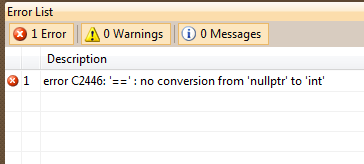
This class is making a small (and perhaps not entirely sane) assumption, namely that we're working with a pointer. In reality, nothing stops us from creating a MyType<int> as well. Since the NULL macro expands as 0 or 0L, the check input == NULL would still work, even though we're using an int (or anything else that is comparable with an integer). This could either compile past this point, and (in best case) throw a compiler error at a later point, or (worse) give us hard-to-track-down runtime errors. In this case, nullptr is usable. Substituting NULL with nullptr will instead give us a compiler error since this check will fail when instantiating the template:

Figure 1: nullptr to the rescue

This is obviously just a small example, but the idea is to show that we get a mismatch between the NULL macro and the idea of a null pointer.


2.2 - Type inference - Redefinition of auto
Yes, C++ now has type inference, meaning we don't have to explicitily instruct the compiler about the type when declaring variables. Its basic usage is:

auto varName = someInstance.GiveMeSomething();

The
auto keyword has been redefined. In previous versions, its usage has been to declare an automatic variable, meaning a variable whose lifetime is bound to its scope. Sounds familiar? It probably should, since this is the default behaviour for every variable created on the stack in C++. When was the last time you actually (explicitily) declared an variable as automatic?

One situation (out of many), where I find this useful, is when declaring stuff like iterators. It's quite nice to use with lambdas as well (as we shall see later). For instance. Suppose we want to iterate over an STL-list and want to declare an iterator:


list<string>::iterator beginIter = names.begin();

... Well, now we could do the following instead:

auto beginIter = names.begin();

But type inference is not only syntactic sugar. As shown in the C++ 0x FAQ by Bjarne Stroustrup, this is even more valuable when the exact type is more or less impossible (or at least hard) for the programmer to deduct. Consider the following example (borrowed from the aforementioned FAQ):

template<typename T, typename U> 
void multiply(const vector<T>& vt, const vector<U>& vu)
{
    // ...
    auto tmp = vt[i]*vu[i];
    // ...
}

The elements in the input vectors are of type T and type U. We're multiplying two elements and assigning the result to a temporary variable (tmp). The type of this variable is dependent on the typenames. In this case, auto is an invaluable tool to deduce the type of tmp depending on the actual template parameters.

I received some mixed comments whether type inference is too obscuring or not. Personally, I love it. It reminds me a lot of the type inference in C# (using the var keyword). It forces you to think your variable naming through and actually give them semantically meaningful names.


2.3 - Lambdas
Basic syntax:

[](){};                   // Implicit return type

[]() -> return_type {};   // Explicit return type

Lambdas in C++ serve a very useful purpose. Basically, we're talking about anonymous functions with the ability to capture variables in the scope where the lambda is defined. This means that we can use C++ lambdas as closures (or not, if we prefer that). This is a concept not so much from the object oriented paradigm, but from functional programming.


The ABSOLUTELY simplest case (which will actually compile) is:

[](){};


The square brackets is called the capture clause. Here, you'll define which variables from the outlying scope you want to capture (meaning: have access to inside the lambda). For instance, to capture everything by reference or by value, we would do the following:


[&](){}; 
// Capture everything by reference
[=](){};  // Capture everything by value


The parentheses are the function argument list and the curly brackets are the method body. The return type is either infered from usage or explicit from the declaration. A few quick examples:


Lambda example 1:
// An alternative to function pointers,
// Combined with the auto keyword:
auto add = [](int a, int b){ return a+b; };
int sum = add(4,5);

Lambda 
example 2:
// Same as before, explicit return type:
auto add = [](int a, int b) -> int{ return a+b; };
int sum = add(4,5);

Lambda example 3:

// Capturing all local variables as references
auto myLambda = [&]() -> int{ // Body };

// ... And as values:
auto  myLambda  = [=]() -> int{ // Body };


Lambda example 4:
// Capturing one external variable by reference, 
// and one by value:
int x = 5;int y = 10;

// Defining the lambda

auto lambda = [&x, y]() {
    x++; // OK
    y++; // Not OK
};


2.3.1 - When to use lambdas
I tend to use lambdas instead of C++ Functors (and function/function pointers). For instance, when iterating with a for_each loop. I normally did the following in C++ 98:

list<int> values;
MyFunctor func;

// ... Populate "values"

// Iterate collection
for_each(values.begin(), values.end(), func);

... Where MyFunctor was a function object on the following form:

class MyFunctor {
public:
    void operator()(int obj) {
        // Do stuff here on each iteration
    }
};

Since lambdas, this iteration has now been reduced to:

for_each(values.begin(), values.end(), [&](){
    // Do stuff here on each iteration
});

There ARE still scenarios when we might want to use something else than a lambda, of course. But nevertheless, it's a nice and powerful feature which I'll gladly use.


2.4 - Varied smart pointers and the deprecation of auto_ptr
Smart pointers has been around for some time. Basically, we're wrapping raw pointers in a class that can be created as an automatic variable instead, leaving cleanup to the destructor call when we're running out of scope. 

We've hade the auto_ptr for some time (
with all its flaws). For instance, the semantics of auto_ptr means a strict ownership; If you try to copy one auto_ptr to another, the first auto_ptr give its ownership up to the second one. If the second auto_ptr already owns a resource, this will get freed up first. This meant that some algorithms (such as some sort algorithms in the standard library) that relied upon making local copies of elements stopped working correctly.

Anyway: auto_ptr is being deprecated in favour of unique_ptr. We also have access to yet another smart pointer type called shared_ptr. They both have their background in the Boost library. Their basic usage is:

unique_ptr<SomeType> uPtr(new SomeType(5));
shared_ptr<SomeType> sPtr = make_shared<SomeType>(5);
The basic idea of these pointers is the same as before: We're wrapping a raw pointer in another class. Since we're creating uPtr and sPtr as ordinary variables, we're creating them on the stack, not the heap, meaning their destructors will get called automatically when they're running out of scope. The wrapped raw pointer is created on the heap, but will get deleted as soon as the unique_ptr instance is destroyed. A really nice feature with this design is that we're taking advantage of the C++ stack unwinding, meaning we're cleaning up our resources even if an exception is thrown (this is not the case with raw pointers).

Other than that, the major difference between shared_ptr and unique_ptr is that shared_ptr allows several shared pointers to contain the same pointer. It keeps track of the number of instances with an internal counter which decreases everytime a shared pointer goes out of scope. The actual resource is not cleaned up until the last shared_ptr has exited its scope (setting the counter to 0). 


A unique_ptr instance on the other hand, has the same idea of strict ownership as the auto_ptr, but with one major difference. While you COULD "copy" an auto_ptr (or rather: give the resource up), the assignment operator of the unique_ptr is non-public, meaning you'll get a compiler error if you try to assign it. This is definitely an improvement over auto_ptr.


Bottom line: Avoid raw pointers. Use smart pointers.


3. Conclusion
As I said in the beginning of this article, this is not an exhaustive list of C++ 11 features. Far from it. I've not even touched some of the larger areas, such as threads or variadic templates. The things that I've talked about in this post is relatively small changes, but still something that could have a huge impact on your code. I for one, don't write for_each-loops without using lambda expressions anymore. It would have been fun to write about more features and add more examples and descriptions, but this is starting to be quite a long blog post. I might write another C++ article in the future though :)


4. Useful links from the article
The following links has been present in the article. They provide content for reading more in-depth about everything that I've written about in this article.

  1. Scott Meyer's Effective C++
  2. Edument - Development and mentorship
  3. cplusplus.com on the NULL macro
  4. Wikipedia on Type Inference
  5. Wikipedia on automatic variables
  6. The C++ 11 FAQ by Bjarne Stroustrup
  7. The flaws of the auto_ptr class
  8. Boost C++ libraries
  9. MSDN on Stack Unwinding in C++